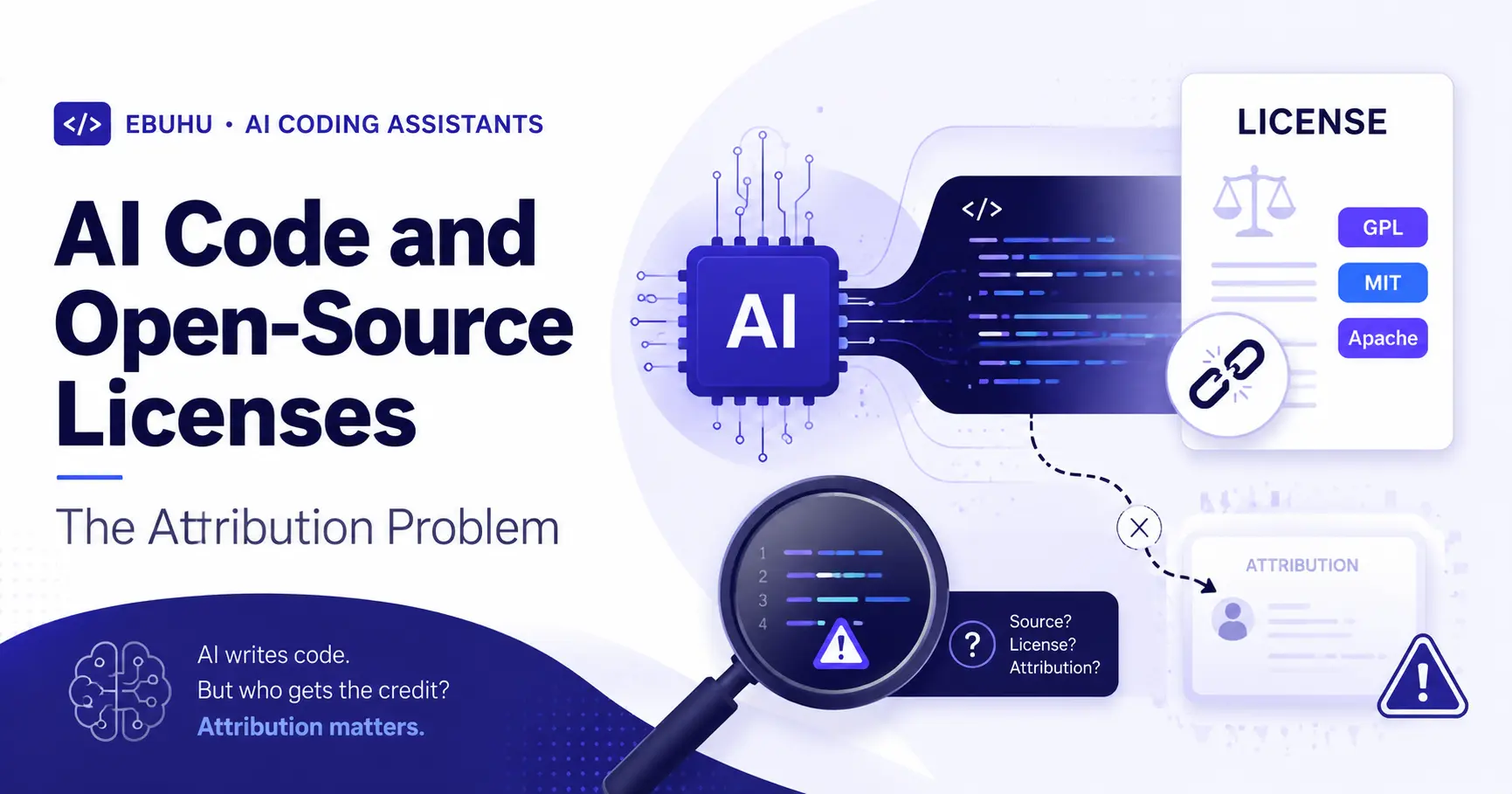
Code a human developer copies from a GPL-licensed project usually comes with a visible signal: a file header, a comment, a link, something that prompts the question “what license is this under?” Code generated by an AI assistant trained on that same GPL-licensed project can reproduce a recognizable fragment of it with none of those signals attached, because the model’s output carries no memory of where a pattern came from. That is the specific problem this piece is about, and it is not legal advice: it explains why the risk exists and what mitigation actually looks like, without declaring any specific snippet contaminated or clean.
How it happens
AI coding models are trained on enormous public code corpora, and that training data includes repositories released under GPL, LGPL, AGPL and other copyleft licenses alongside permissively licensed and proprietary code. When a model generates a suggestion, it can reproduce a fragment closely resembling copyleft-licensed original code it was trained on, and the output gives you nothing that would let you tell: no license header, no attribution comment, no indication the pattern originated somewhere with terms attached. A developer manually copying the same fragment from its source would at minimum see the repository, the license file, and the header. An assistant’s output strips all of that context away by the nature of how it generates text, not through any deliberate concealment.
What GPL-style contamination actually requires, if it applies
Copyleft licenses like the GPL work on the principle that a derivative work incorporating GPL-licensed code must itself be distributed under the same license terms. If code genuinely derived from a GPL-licensed original ends up inside a proprietary codebase without anyone noticing, the licensing obligation described in that framework would in principle attach to the derivative work, including code around it that was written independently. This is the mechanism referred to in coverage of this issue as “contamination,” and a research framework referenced in reporting as DevLicOps documented real cases where license-contamination incidents from AI coding tools caused product delays and, in some cases, rewrites at large companies. Whether any specific piece of AI-generated code actually meets the legal threshold for being a derivative work in this sense is a fact-specific determination this article cannot make for you. What can be said is that the underlying mechanism is documented and has produced real commercial consequences, not that it is a certainty in any individual case.
What vendor terms of service do and do not cover
AI vendors’ terms of service generally disclaim responsibility for copyright or license infringement present in generated output, placing that risk with the person or organization using the output rather than the provider that generated it. Reporting on this describes the practical effect as “license laundering”: code that would carry a clear license obligation if copied by hand can arrive through a model with no attribution, no visible warning, and a vendor agreement that does not accept responsibility for the result. Knowing this shifts the practical question from “will the vendor catch this for me” to “what can I realistically do to catch it myself,” which is where mitigation actually has to live.
Realistic mitigation
License-aware scanning tools are becoming a specific product category for this exact gap, checking generated code against known copyleft-licensed originals rather than relying on a human noticing a familiar-looking pattern. This is presented as an emerging capability rather than a solved, universally reliable check as of when this was researched, and the tooling’s maturity is worth verifying against current vendor claims rather than assumed.
Provenance-aware review is worth applying specifically to anything going into a commercially significant or widely distributed codebase, more so than to an internal script or a personal project where the consequences of an unnoticed contamination are lower. This is a matter of proportional effort, not a claim that lower-stakes code carries zero risk.
For anything where the commercial or legal exposure is genuinely significant, this is where a lawyer, not a scanning tool, becomes the appropriate resource. No tool available today can definitively rule contamination in or out with certainty across every case, and the DevLicOps-documented incidents involved real legal and business consequences, not just theoretical exposure.
This risk sits directly next to the separate question of who actually owns AI-generated code in the first place: ownership and license contamination are related but distinct questions, and a piece of code can raise either, both, or neither depending on its specific origin. It is also the same underlying problem, in a different form, as a hallucinated npm package with no attribution trail of its own: in both cases, the AI-generated output gives you no built-in signal that something needs checking, so the checking has to be a deliberate habit rather than something the tool prompts you to do.
FAQ
Does this mean I should not use AI coding assistants for commercial projects?
This article does not make that recommendation either way. It describes a documented risk and realistic mitigation steps so the decision, and the level of review effort applied, can be made with the risk understood rather than unknown.
Is there a way to know for certain if a piece of AI-generated code is contaminated?
Not with complete certainty using tools available broadly as of when this was researched. License-aware scanning tools are an emerging mitigation, not a guaranteed, complete answer, which is part of why proportional review effort and legal counsel for high-stakes cases both remain part of the realistic answer.
Does the AI vendor bear any responsibility if their tool generates contaminated code?
Vendor terms of service generally disclaim this responsibility, placing the risk with the user of the output rather than the provider. This is a term of the specific agreement you accepted, not a universal legal principle, so check the actual terms of the tool in question rather than assuming.
Is this risk specific to GPL, or does it apply to other licenses too?
The GPL is used here because its copyleft mechanism is the most consequential version of this risk, but the underlying problem, generated code resembling licensed original code with no attribution signal, is not unique to any single license category.
Should every AI-generated function get a license-contamination review?
Proportional to what the code is for is the realistic approach: something going into a widely distributed or commercially significant product warrants more scrutiny than an internal script, given the documented cases involved real business consequences rather than only theoretical risk.